Multiscale modeling of metallic glass by a direct coarse-graining from the atomic scale to the continuum level
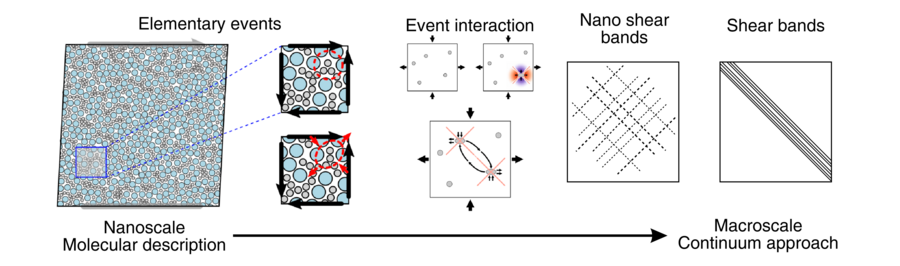
Metallic glasses are metals that possess an amorphous, “glass‑like” atomic structure. They have attracted significant interest because of their superior strength, high hardness and excellent corrosion resistance, which make them attractive for demanding structural and functional applications. Their deformation, however, is governed by highly localized shear‑transformation zones (STZs) that can result in shear bands. Understanding how these atomic‑scale events translate into macroscopic failure requires a multiscale modeling approach. Consequently, a direct coarse‑graining from the atomic scale to the continuum (macro scale) is essential to capture the unique inelastic behaviour of metallic glasses and to enable reliable predictions of material response.
The aim of this project is to develop a multiscale approach that yields a physically‑meaningful and thermodynamically consistent description of metallic‑glass deformation. At the continuum level a constitutive model is constructed that predicts the macroscopic mechanical response while embedding topological nanoscale information.
In recent years, data‑driven methods based on machine learning have gained increasing attention in material modelling. To guarantee physical and thermodynamic consistency, the concept of explicitly embedding thermodynamic principles into the network architecture has led to Constitutive Artificial Neural Networks (CANNs). Within this framework, essential quantities such as the Helmholtz free‑energy density, the stress–strain relation and the yield condition can be learned directly from experimental data or molecular dynamic simulations MD data while respecting the laws of thermodynamics.
The intended project goal of the project is a continuum‑scale constitutive model built on the CANN framework that learns the inherent physical and thermodynamic material properties from MD simulations, thereby providing a robust, physics‑based tool for predicting the deformation and failure of metallic glasses.